Zimbabwe eVisa 2026: Complete Guide to Types, Fees, and Online Application
The Zimbabwe eVisa is an electronic travel authorization available through the official portal at evisa.gov.zw, allowing eligible travelers from over 40 countries to apply online for entry into Zimbabwe. Single entry costs $30 USD and double entry costs $45 USD, with processing completed in an average of 2 working days. This guide covers every eVisa type, document requirement, fee, and step of the application process.
What Is the Zimbabwe eVisa?
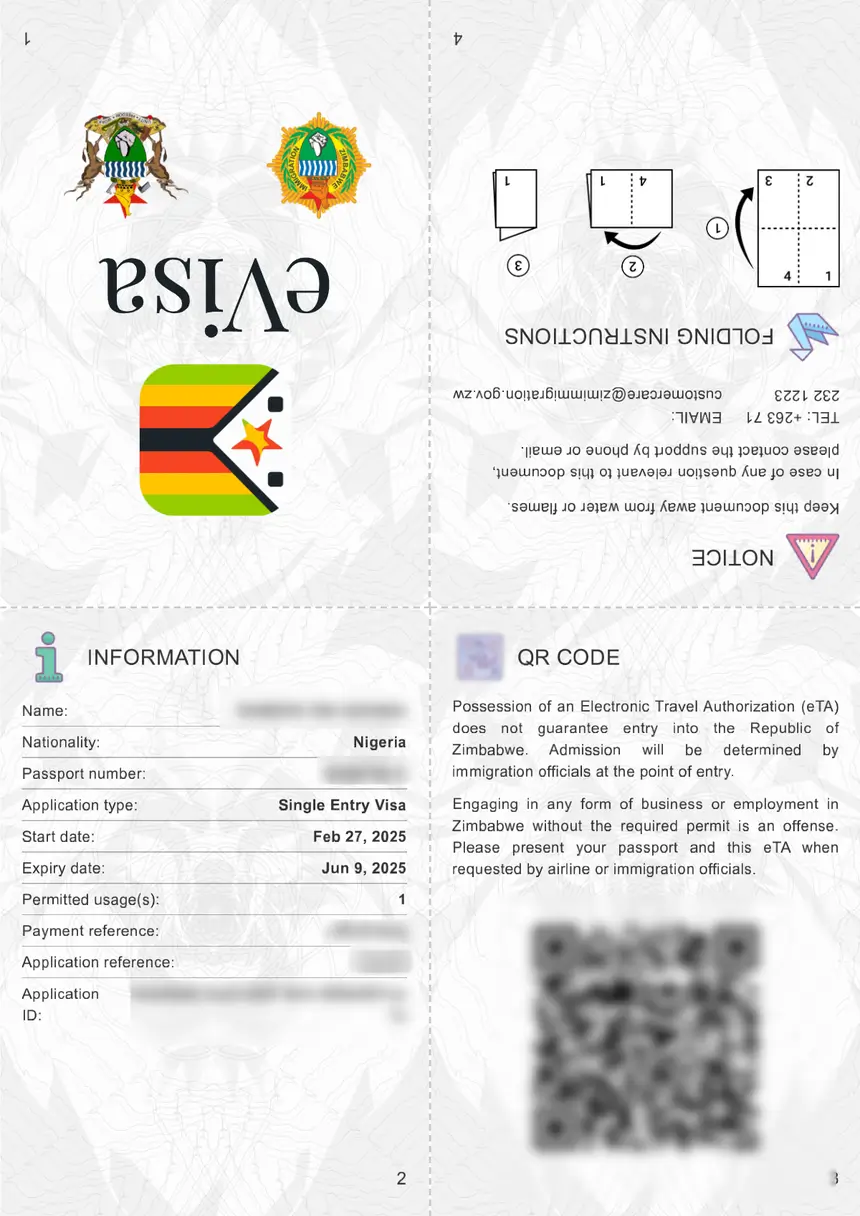
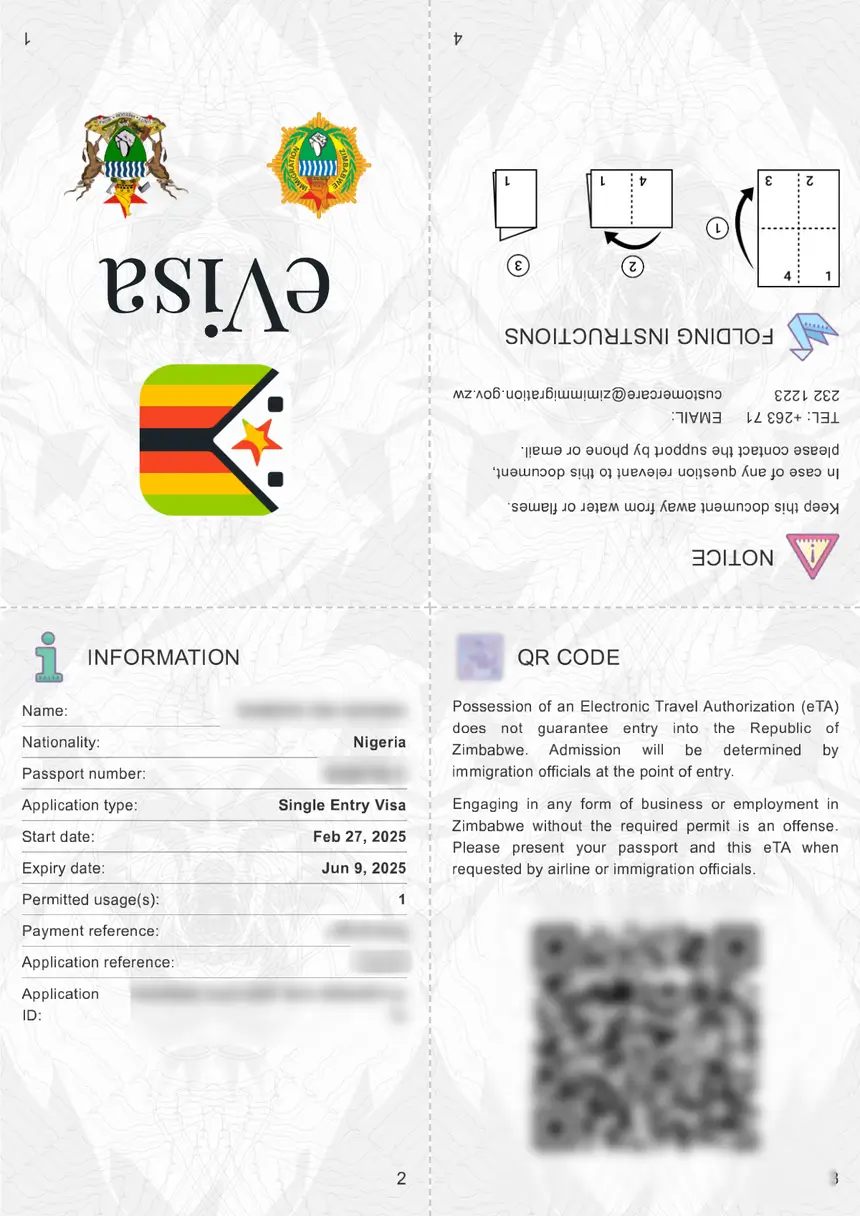
The Zimbabwe eVisa is an online visa issued by the Zimbabwe Department of Immigration through evisa.gov.zw, valid for 3 months from the date of issue, allowing entry at 9 designated ports across the country.
The Zimbabwe eVisa replaced the traditional embassy-visa process for eligible nationalities, enabling travelers to complete their entire application from any device with internet access. The electronic visa system covers tourist, business, transit, and conference travel purposes.
The eVisa is linked to your passport number and presented as a printed or digital confirmation at the port of entry. Immigration officers verify the eVisa against the passport at one of the 9 designated entry points, which include Harare International Airport, Victoria Falls Airport, Joshua Mqabuko Nkomo International Airport, and major land border crossings at Beitbridge, Chirundu, Plumtree, Forbes-Mutare, Nyamapanda, and Kariba.
The Zimbabwe eVisa is distinct from a visa on arrival (obtained at the border) and the KAZA Univisa (a joint Zimbabwe-Zambia visa). Travelers who hold an eVisa have pre-approved entry authorization, which reduces processing time at immigration and eliminates uncertainty about visa approval at the border.
Zimbabwe eVisa Types
Zimbabwe offers 4 eVisa categories – Transit, Holiday, Conference, and Business – each with specific validity periods ranging from 30 to 90 days and options for single or double entry.
Transit eVisa
The Transit eVisa allows travelers to pass through Zimbabwe briefly while traveling to a third-country destination.
- Validity: 30 days from issue
- Maximum stay: 7 days
- Entry type: Single entry only
- Use case: Layovers, connecting travel through Zimbabwe
Holiday eVisa (Tourist)
The Holiday eVisa is the most common type, designed for tourism, leisure, sightseeing, and visiting friends or family in Zimbabwe.
- Validity: 30 days or 90 days from issue
- Maximum stay: 30 days per visit
- Entry type: Single or double entry
- Use case: Tourism, vacation, family visits
Conference eVisa
The Conference eVisa is for travelers attending international conferences, seminars, workshops, or professional events in Zimbabwe.
- Validity: 30 days or 90 days from issue
- Maximum stay: 30 days
- Entry type: Single or double entry
- Use case: Conferences, seminars, workshops, professional events
Business eVisa
The Business eVisa covers business-related activities such as meetings, negotiations, site visits, and commercial discussions.
- Validity: 30 days or 90 days from issue
- Maximum stay: 30 days
- Entry type: Single or double entry
- Use case: Business meetings, negotiations, commercial activities
Important: Do not apply under the wrong eVisa type. If your travel purpose does not match any eVisa category, contact the nearest Zimbabwean embassy or consulate for the correct visa option. Volunteer work requires a business visa.
| eVisa Type | Validity | Max Stay | Entries | Fee (Single) | Fee (Double) |
|---|---|---|---|---|---|
| Transit | 30 days | 7 days | Single | $30 | N/A |
| Holiday | 30 or 90 days | 30 days | Single/Double | $30 | $45 |
| Conference | 30 or 90 days | 30 days | Single/Double | $30 | $45 |
| Business | 30 or 90 days | 30 days | Single/Double | $30 | $45 |
Who Needs a Zimbabwe eVisa?
Zimbabwe classifies foreign nationals into three categories: Category A (visa-exempt, no visa needed), Category B (visa on arrival available), and Category C (eVisa required before travel).
Category A – Visa-Exempt Countries
Citizens of Category A countries can enter Zimbabwe without any visa for up to 3 months. These include:
- Africa: Angola, Botswana, Democratic Republic of Congo, Eswatini, Ghana, Kenya, Lesotho, Madagascar, Malawi, Mauritius, Mozambique (30 days), Namibia, South Africa, Tanzania, Uganda, Zambia
- Caribbean: Antigua and Barbuda, Bahamas, Barbados, Belize, Grenada, Jamaica, Saint Kitts and Nevis, Saint Lucia, Saint Vincent and the Grenadines, Trinidad and Tobago
- Asia-Pacific: Hong Kong (6 months), Fiji, Kiribati, Malaysia, Maldives, Nauru, Samoa, Seychelles, Singapore, Solomon Islands, Tonga, Tuvalu, Vanuatu
- Europe: Cyprus, Malta
Category B – Visa on Arrival
Citizens of Category B countries can obtain a visa at the port of entry. This includes:
- European Union member states (except Cyprus and Malta, which are visa-exempt)
- Major countries: United States, United Kingdom, Canada, Australia, New Zealand, Japan, China, India, Brazil, Russia, South Korea, Turkey, Argentina, Mexico, and many others
- Visa on arrival fee: $30 (single entry), $45 (double entry), $55 (multiple entry)
- Validity: 30 days, extendable up to 90 days for tourism
Category C – eVisa Required
Citizens of Category C countries must apply for an eVisa online before traveling to Zimbabwe. This includes nationals of approximately 40 countries such as Bangladesh, Nigeria, Pakistan, Ghana (some categories), and others not covered by Categories A or B.
How to determine your category: Visit the Zimbabwe Department of Immigration website or check the official eVisa portal at evisa.gov.zw, which indicates eligibility based on your nationality during the application process.
Zimbabwe eVisa Requirements
All Zimbabwe eVisa applicants must provide a passport valid for at least 6 months with 3 blank pages, a recent passport photograph, and proof of residence in their country of origin or domicile.
Universal Requirements (All eVisa Types)
- Valid passport with at least 6 months validity from the date of arrival in Zimbabwe
- 3 blank pages in the passport (for entry/exit stamps and potential transit through neighboring countries)
- Recent passport-size photograph (digital upload)
- Proof of residence in your country of origin or domicile (utility bill, lease agreement, or government-issued document)
- Return or onward ticket (recommended)
- Accommodation booking or invitation letter (recommended)
Additional Requirements by Visa Type
Yellow Fever Certificate
If you are traveling from or through a country classified as a yellow fever transmission risk, you must present a valid yellow fever vaccination certificate upon entry to Zimbabwe. This applies regardless of your nationality.
Financial Requirements
While not always checked, travelers should be prepared to demonstrate sufficient funds for their stay. Zimbabwe also enforces a strict cash limit: it is illegal to leave Zimbabwe with more than $2,000 USD in cash. Declare any cash or traveler’s checks of $10,000 USD or more upon entry.
How to Apply for Zimbabwe eVisa
Apply for your Zimbabwe eVisa in 3 steps at evisa.gov.zw: complete the online form, upload your documents and pay the fee, then receive your approved eVisa by email.
Step 1: Complete the Online Application
- Visit www.evisa.gov.zw and create an account or log in
- Select your visa type (Transit, Holiday, Conference, or Business)
- Choose single or double entry
- Fill in personal details: full name (as on passport), date of birth, nationality, passport number
- Enter travel details: intended date of arrival, port of entry, accommodation address
- Provide your email address (this is where the eVisa will be sent)
Step 2: Upload Documents and Pay
- Upload a scanned copy of your passport bio page
- Upload a passport-size photograph (digital format)
- Upload proof of residence in your country of origin
- Upload any additional documents based on your visa type (invitation letter, conference registration, etc.)
- Pay the visa fee online: $30 for single entry or $45 for double entry
- Payment can be made by credit or debit card
Step 3: Receive Your eVisa
- Wait for processing (average 2 working days, up to 10 business days)
- Check your email for the eVisa approval notification
- Download and print the eVisa confirmation (also keep a digital copy on your phone)
- Present the printed eVisa along with your passport at the port of entry
Tip: Apply at least 2 weeks before your travel date to allow for any processing delays. Do not book non-refundable flights until your eVisa is approved.
Zimbabwe eVisa Fees
The Zimbabwe government charges $30 USD for a single-entry eVisa and $45 USD for a double-entry eVisa, payable by credit or debit card during the online application.
Government Fees (Direct Application at evisa.gov.zw)
Third-Party Service Fees
Several third-party services offer eVisa application assistance. These services review your application before submission and provide support throughout the process:
Comparison with Visa on Arrival Fees
Note: The eVisa fee is the same as the visa on arrival fee for most nationalities. The advantage of the eVisa is guaranteed pre-approval, eliminating the risk of unexpected issues at the border.
Zimbabwe eVisa Processing Time
Standard Zimbabwe eVisa processing takes an average of 2 working days, though the official maximum is 10 business days; rush processing options through third-party services can reduce this to 1-3 days.
Standard Processing
- Average time: 2 working days (based on user reports and official estimates)
- Maximum time: Up to 10 business days (official guidance from evisa.gov.zw)
- Factors affecting time: Application completeness, nationality, visa type, current volume
Tips for Faster Processing
- Submit a complete application with all required documents on the first attempt
- Ensure your passport scan is clear and legible
- Use a high-quality photograph that meets passport photo standards
- Apply during business hours (Zimbabwe time, GMT+2) for faster initial review
- Double-check all information before submitting to avoid rejection and reapplication delays
What Happens After Approval
- You receive an email notification with your approved eVisa
- Download the eVisa confirmation PDF from the portal or email
- Print at least 2 copies of the eVisa confirmation
- Carry the printed copies with your passport when traveling
- Present at the immigration counter upon arrival in Zimbabwe
eVisa vs Visa on Arrival vs KAZA Univisa
The Zimbabwe eVisa ($30-$45) provides pre-travel approval through evisa.gov.zw, visa on arrival ($30-$55) is obtained at the border, and KAZA Univisa ($50) covers both Zimbabwe and Zambia for 30 days.
When to Choose Each Option
- Choose eVisa if: You want guaranteed entry approval before traveling, your nationality requires it (Category C), or you prefer to handle paperwork in advance
- Choose Visa on Arrival if: Your nationality qualifies (Category B), you prefer simplicity, or you are making a last-minute trip
- Choose KAZA Univisa if: You plan to visit both Zimbabwe and Zambia (and possibly do a day trip to Chobe National Park in Botswana), and your nationality is among the 65 eligible countries
Zimbabwe eVisa Entry Points
eVisa holders can enter Zimbabwe through 9 designated crossings: 3 international airports and 6 major land border posts.
Airports
- Robert Gabriel Mugabe International Airport (Harare) – Main international airport
- Victoria Falls Airport – Serves Victoria Falls tourism region
- Joshua Mqabuko Nkomo International Airport (Bulawayo) – Second largest city airport
Land Border Crossings
- Beitbridge – Zimbabwe-South Africa border (busiest land crossing)
- Chirundu – Zimbabwe-Zambia border (on the Great East Road)
- Plumtree – Zimbabwe-Botswana border
- Forbes – Mutare – Zimbabwe-Mozambique border
- Nyamapanda – Zimbabwe-Mozambique border (northern)
- Kariba – Zimbabwe-Zambia border (Lake Kariba area)
Important: If you enter Zimbabwe through a port of entry not on this list, your eVisa may not be accepted. Verify your intended entry point before applying. The KAZA Univisa is available only at Harare Airport, Victoria Falls Airport, Victoria Falls land border, and Kazungula.
Checking Your Zimbabwe eVisa Status
Track your Zimbabwe eVisa application status through the evisa.gov.zw portal using your application reference number, or monitor your email for status updates from the immigration department.
Method 1: Online Portal
- Log in to your account at www.evisa.gov.zw
- Navigate to “My Applications” or “Track Status”
- Enter your application reference number
- View current status: Submitted, Under Review, Approved, or Rejected
Method 2: Email Notifications
The Zimbabwe Department of Immigration sends email updates at key stages:
– Application received – confirmation email with reference number
– Under review – application is being processed
– Approved – eVisa confirmation attached as PDF
– Rejected – reason for rejection provided
Status Meanings
Common eVisa Mistakes to Avoid
The most common Zimbabwe eVisa rejections result from expired passports, missing documents, selecting the wrong visa type, or providing inconsistent information on the application form.
Top 7 Application Mistakes
-
Passport validity less than 6 months – Your passport must be valid for at least 6 months from your intended date of arrival in Zimbabwe. Renew your passport before applying if it expires within 6 months.
-
Fewer than 3 blank pages – Zimbabwe requires 3 blank passport pages. This is more than the typical 1-2 pages required by most countries. Check your passport before applying.
-
Wrong visa type selected – Choosing Tourist when you need Business, or selecting Transit when your stay exceeds 7 days. Match the visa type to your actual travel purpose.
-
Missing proof of residence – A utility bill, lease agreement, or government-issued document showing your current address in your country of origin or domicile is required.
-
Blurry or illegible document scans – Passport bio page and photograph must be clear and readable. Rescan documents if the quality is poor.
-
Incorrect passport number or personal details – Any mismatch between your application form and passport will result in rejection. Double-check all entries before submitting.
-
Applying too late – While processing averages 2 days, it can take up to 10 business days. Apply at least 2 weeks before your travel date.
What to Do If Your eVisa Is Rejected
If your Zimbabwe eVisa application is rejected, the notification email will include the reason. Common fixes include:
– Resubmitting with corrected information
– Uploading missing or clearer documents
– Selecting the correct visa type
– Applying for a visa on arrival instead (if your nationality qualifies as Category B)
FAQs About Zimbabwe eVisa
Do US citizens need a Zimbabwe eVisa?
US citizens need a visa to enter Zimbabwe but can obtain it either as a visa on arrival at the port of entry ($30 single / $45 double) or as an eVisa applied for in advance through evisa.gov.zw. US citizens fall under Category B (visa on arrival eligible).
How long does it take to get an eVisa for Zimbabwe?
Standard processing averages 2 working days but can take up to 10 business days. Third-party rush services offer processing in 3-5 days, and super-rush services in 1-3 days.
How much is the Zimbabwe eVisa?
The government fee is $30 USD for single entry and $45 USD for double entry, payable by credit or debit card. Third-party assistance services charge $35-$100 additional depending on processing speed.
Can I get a visa on arrival instead of an eVisa?
Yes, if your nationality falls under Category B (which includes US, UK, EU, Canadian, Australian, and many other nationalities). Category C nationalities must apply for the eVisa before travel.
What is the KAZA Univisa and how does it differ from the eVisa?
The KAZA Univisa costs $50 USD and is valid for 30 days, covering both Zimbabwe and Zambia. It is available to citizens of 65 eligible countries and can be obtained at select airports and border crossings. The standard eVisa covers only Zimbabwe.
How long is the Zimbabwe eVisa valid?
The eVisa is valid for 3 months (90 days) from the date of issue. You must enter Zimbabwe within this validity period. Once entered, your maximum stay is determined by the visa type (7 days for transit, 30 days for others).
What documents do I need for the Zimbabwe eVisa?
You need a valid passport (6+ months validity, 3 blank pages), a passport-size photograph, and proof of residence in your country of origin. Additional documents depend on your visa type (hotel booking for tourist, invitation letter for business/conference).
Can I extend my Zimbabwe eVisa?
Yes, visa extensions are possible through the Zimbabwe Department of Immigration. Tourist visas can be extended up to 90 days total. Visit the Government of Zimbabwe Immigration Department in person to apply for an extension.
Is the Zimbabwe eVisa the same as a visa on arrival?
No. The eVisa is applied for and approved online before travel through evisa.gov.zw. A visa on arrival is obtained at the port of entry. Both serve the same purpose but the eVisa provides pre-approval certainty.
What happens if my eVisa application is rejected?
You will receive an email with the reason for rejection. You can correct the issue and reapply, or if your nationality qualifies (Category B), you can obtain a visa on arrival instead.
Can I use the Zimbabwe eVisa to enter Zambia?
No. The standard Zimbabwe eVisa is valid only for entry into Zimbabwe. To visit both Zimbabwe and Zambia, apply for the KAZA Univisa ($50), which covers both countries for 30 days.
How many times can I enter Zimbabwe with an eVisa?
Single-entry eVisa allows one entry. Double-entry eVisa allows two entries within the validity period. For multiple entries, consider the visa on arrival multiple-entry option ($55) if your nationality qualifies.
Do I need travel insurance for Zimbabwe?
Travel insurance is not a mandatory requirement for the Zimbabwe eVisa, but it is strongly recommended. Medical facilities in Zimbabwe may require upfront payment, and travel insurance covers medical emergencies, trip cancellation, and lost luggage.
Can I work in Zimbabwe with an eVisa?
No. The tourist, business, and conference eVisas do not authorize employment in Zimbabwe. To work, you need a temporary work permit, which requires a separate application through the Zimbabwe Department of Immigration.
What ports of entry accept the Zimbabwe eVisa?
The eVisa is accepted at 9 designated crossings: Harare International Airport, Victoria Falls Airport, Joshua Nkomo Airport (Bulawayo), and land borders at Beitbridge, Chirundu, Plumtree, Forbes-Mutare, Nyamapanda, and Kariba.