Zimbabwe eVisa Requirements: Complete Document Checklist for 2026
Zimbabwe eVisa requirements include a passport valid for 6 months, a recent photograph, proof of accommodation, return travel documentation, and financial evidence. The specific documents vary by visa type and your nationality category. This guide covers every requirement for a successful application through evisa.gov.zw.
Core Documents Required for Zimbabwe eVisa
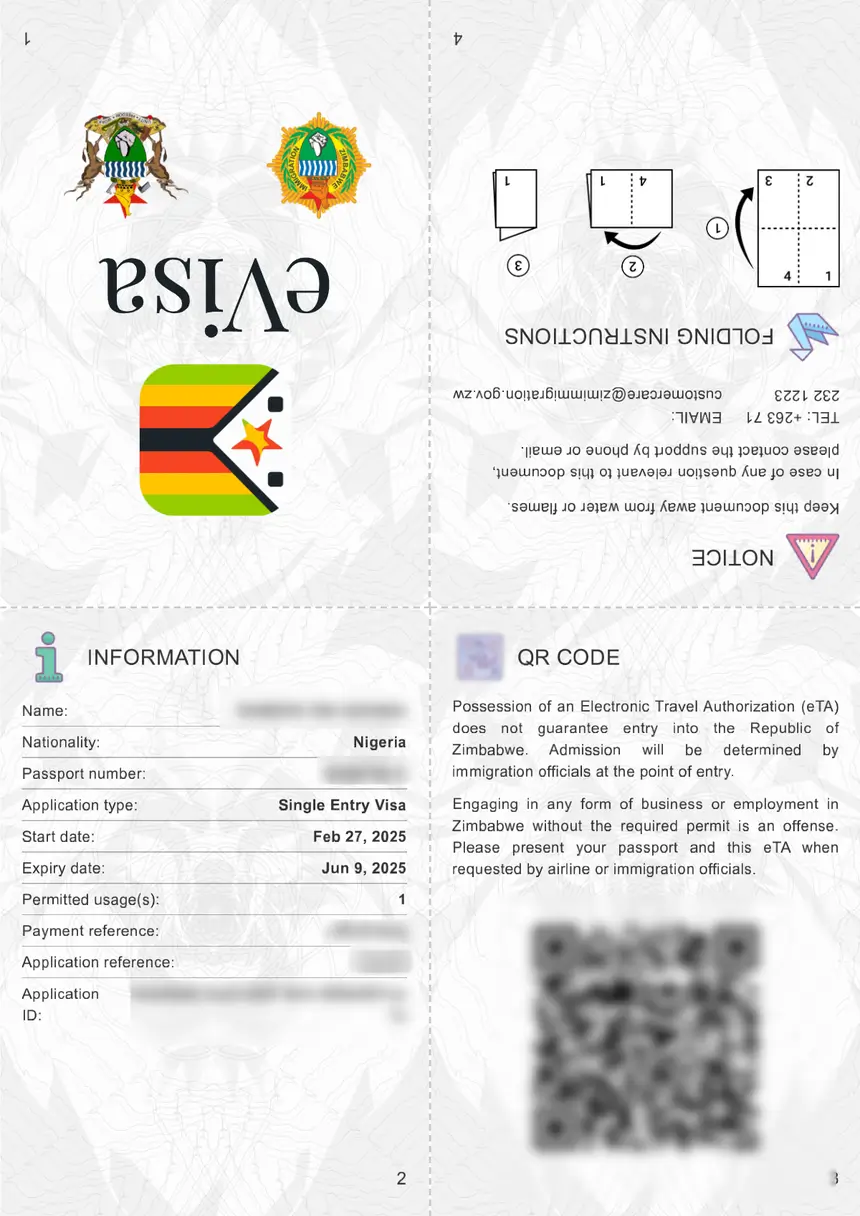
Every Zimbabwe eVisa applicant must provide five core documents: a valid passport, a recent passport-sized photograph, proof of accommodation in Zimbabwe, a return or onward travel itinerary, and evidence of financial means. These documents form the baseline for all four eVisa categories (Transit, Holiday, Conference, and Business).
The application is submitted entirely online through the official portal at evisa.gov.zw, managed by the Zimbabwe Department of Immigration. There is no need to visit an embassy or consulate. Documents are uploaded digitally during the application process.
The eVisa costs $30 USD for single entry and $45 USD for double entry. Processing takes an average of 2 working days, though it can take longer during peak travel periods. Once approved, the eVisa is valid for 3 months from the date of issue and must be used at one of the 9 designated entry points, including Harare International Airport, Victoria Falls Airport, and major land border crossings at Beitbridge, Chirundu, and Plumtree.
If you are unsure whether you need an eVisa, check the complete Zimbabwe eVisa guide for the full category system and exemption lists.
Passport Requirements
Your passport must be valid for at least 6 months beyond your planned arrival date in Zimbabwe and contain a minimum of 3 blank visa pages.
Validity Period
The 6-month validity rule is strictly enforced. If your passport expires within 6 months of your arrival date, your eVisa application will be rejected. Renew your passport before applying if it does not meet this requirement.
Blank Pages
Immigration officers need at least 3 blank pages in your passport for entry and exit stamps. Pages marked “Amendments” or “Endorsements” do not count. If you are traveling to both Zimbabwe and Zambia (for example, visiting Victoria Falls from both sides), you may need additional blank pages.
Digital Scan Requirements
- The full biographic page (photo page)
- All four corners visible and unobstructed
- Clear, readable text with no glare or shadows
- Minimum resolution of 300 DPI
- File format: PDF or JPEG, maximum 2 MB
When uploading your passport during the application, ensure the scan includes:
Photo Requirements
Upload a recent passport-sized photograph with a plain white background, taken within the last 6 months, showing your full face without glasses or head coverings (unless for religious reasons).
- Dimensions: 35mm x 45mm (standard passport size)
- Background: Plain white or off-white
- Face position: Centered, covering 70-80% of the frame
- Expression: Neutral, mouth closed, eyes open
- Glasses: Not permitted (unless medically necessary)
- Head coverings: Permitted only for religious purposes, must not obscure the face
- File format: JPEG or PNG, maximum 2 MB
- Resolution: Minimum 600 x 600 pixels
The photograph must meet these specifications:
Photos that are blurry, overexposed, taken against a colored background, or older than 6 months are common reasons for application rejection.
Financial Proof Requirements
Provide bank statements from the last 3 months demonstrating sufficient funds to cover your stay in Zimbabwe, along with evidence of your employment or income source.
Bank Statements
- Personal bank statements covering the most recent 3 months
- Employer letter confirming your position, salary, and approved leave dates
- Sponsorship letter if someone else is funding your trip, accompanied by their bank statements
The Department of Immigration requires proof that you can financially support yourself during your visit. Accepted documents include:
There is no officially published minimum balance, but statements should show consistent activity and enough funds to cover accommodation, meals, and transport for the duration of your stay. A reasonable guideline is $100-150 USD per day of your planned visit.
Sponsorship
If a Zimbabwean resident or organization is sponsoring your visit, they must provide a signed letter confirming their commitment to cover your expenses, along with proof of their financial capacity.
Requirements by Visa Type
Zimbabwe offers four eVisa categories, each with specific additional requirements beyond the core documents.
Transit eVisa
- Purpose: Passing through Zimbabwe to a third-country destination
- Additional requirement: Proof of onward travel (confirmed flight or bus ticket to your next destination)
- Validity: 30 days from issue, maximum 7 days stay
- Entry type: Single entry only
- Fee: $30 USD
Holiday eVisa (Tourist)
- Purpose: Tourism, sightseeing, visiting friends or family
- Additional requirement: Hotel booking confirmation or host’s address and contact details
- Validity: 30 or 90 days from issue, maximum 30 days per visit
- Entry type: Single or double entry
- Fee: $30 single / $45 double
Conference eVisa
- Purpose: Attending conferences, seminars, workshops, or professional events
- Additional requirement: Invitation letter from the hosting organization in Zimbabwe, including event dates, venue, and purpose
- Validity: 30 or 90 days from issue, maximum 30 days
- Entry type: Single or double entry
- Fee: $30 single / $45 double
Business eVisa
- Purpose: Business meetings, negotiations, site visits, commercial activities
- Additional requirement: Invitation letter from a Zimbabwean company, company registration documents, and a letter from your employer
- Validity: 30 or 90 days from issue, maximum 30 days
- Entry type: Single or double entry
- Fee: $30 single / $45 double
For detailed visa fees and payment methods, see the dedicated fee guide.
Nationality Categories and Eligibility
Zimbabwe classifies foreign nationals into three categories – A, B, and C – that determine whether you need an eVisa, can get a visa on arrival, or are exempt from visa requirements entirely.
Category A – Visa-Exempt Countries
- African nations: Botswana, South Africa, Kenya, Tanzania, Mozambique, Namibia, Zambia, Ghana, Uganda, and others
- Caribbean nations: Jamaica, Barbados, Bahamas, Trinidad and Tobago, and others
- Asia-Pacific: Hong Kong, Malaysia, Singapore, Fiji, and others
Citizens of Category A countries do not need any visa to enter Zimbabwe. They can stay for up to 3 months without prior authorization. Category A includes:
Category B – Visa on Arrival
Category B nationals can obtain a visa at the port of entry. They do not need to apply online in advance, but may choose to apply for an eVisa to speed up the immigration process. This category includes most European Union countries, the United States, Canada, Australia, and New Zealand, among others.
Category C – eVisa Required
Category C nationals must obtain an eVisa before traveling to Zimbabwe. They cannot get a visa on arrival. This category includes nationals from certain countries in Asia, the Middle East, and other regions. If you are in Category C, apply through evisa.gov.zw at least 2 weeks before your travel date.
For the full list of countries in each category, see the visa-free countries guide.
Supporting Documents
Depending on your travel purpose and nationality, you may need additional supporting documents including invitation letters, travel insurance, and vaccination certificates.
Invitation Letter (Business and Conference)
- Full name and details of the inviting organization
- Purpose and duration of your visit
- Confirmation of financial responsibility (if applicable)
- Contact details of the inviting person
- Company registration number or organizational details
If applying for a business or conference eVisa, the invitation letter must include:
Yellow Fever Certificate
Travelers arriving from or transiting through countries with a risk of yellow fever transmission must present a valid yellow fever vaccination certificate. This applies regardless of your nationality. Check the WHO list of risk countries before traveling.
Travel Insurance
While not a mandatory requirement for the eVisa application, comprehensive travel insurance is strongly recommended. It should cover medical emergencies, evacuation, and trip cancellation.
Cash Departure Limit
When leaving Zimbabwe, you cannot carry more than $2,000 USD (or equivalent in other currencies) in cash. Amounts exceeding this must be declared at the port of exit.
Document Upload Specifications
All documents uploaded during the eVisa application must meet specific technical requirements to be accepted by the system.
| Requirement | Specification |
|---|---|
| File formats | PDF, JPEG, PNG |
| Maximum file size | 2 MB per file |
| Minimum resolution | 300 DPI for documents, 600x600px for photos |
| Color mode | Color (not black and white) |
| Orientation | Portrait for documents, correct alignment |
| Quality | Clear, legible, no blur or glare |
- Scan documents in color, not black and white
- Ensure all text is legible at 100% zoom
- Crop scans to remove unnecessary margins
- Avoid photographing documents with a phone camera if possible – use a scanner
- Check file sizes before uploading and compress if necessary
Tips for successful uploads:
Common Reasons for eVisa Rejection
Applications are most frequently rejected due to expired or soon-to-expire passports, poor-quality photographs, missing supporting documents, or mismatched information.
- Passport validity: Less than 6 months remaining from the arrival date
- Photo quality: Blurry, wrong background color, glasses worn, or photo older than 6 months
- Missing documents: Bank statements not provided, accommodation proof missing
- Information mismatch: Name on application does not match passport exactly
- Wrong visa type: Applying for a tourist visa when the purpose is business
- Incomplete application: Leaving required fields blank or providing incorrect contact details
- File format issues: Uploading files in unsupported formats or exceeding the 2 MB limit
The most common rejection reasons include:
If your application is rejected, you can reapply after correcting the issues. The fee is non-refundable, so ensure all documents are complete and accurate before submitting.
For more details on avoiding rejection, see the visa rejection guide.
FAQ (Frequently Asked Questions)
What documents do I need for a Zimbabwe eVisa?
You need a valid passport (6 months validity, 3 blank pages), a recent passport-sized photo on white background, proof of accommodation, return travel itinerary, and bank statements from the last 3 months. Business and conference applicants also need an invitation letter.
How long does it take to get a Zimbabwe eVisa?
Processing takes an average of 2 working days. During peak travel seasons or if additional verification is needed, it may take up to 5 working days. Apply at least 2 weeks before your travel date to allow for any delays.
How much does the Zimbabwe eVisa cost?
A single-entry eVisa costs $30 USD and a double-entry eVisa costs $45 USD. Payment is made online via credit or debit card during the application process at evisa.gov.zw.
Do US citizens need an eVisa for Zimbabwe?
US citizens are classified as Category B, meaning they can get a visa on arrival at the port of entry. However, they can also apply for an eVisa online in advance to speed up the immigration process.
What is the difference between Category A, B, and C?
Category A countries are visa-exempt (no visa needed). Category B countries can get a visa on arrival or apply online. Category C countries must obtain an eVisa before traveling and cannot get a visa on arrival.
Can I work in Zimbabwe with an eVisa?
No. The eVisa (Holiday, Transit, Conference, or Business) does not authorize employment. To work in Zimbabwe, you need a separate work permit obtained through the Department of Immigration.
What photo specifications are required for the Zimbabwe eVisa?
The photo must be 35mm x 45mm, taken within the last 6 months, with a plain white background, neutral expression, no glasses, and minimum 600×600 pixel resolution. Accepted formats are JPEG and PNG, maximum 2 MB.
How much bank balance is required for a Zimbabwe eVisa?
There is no officially stated minimum balance. However, bank statements from the last 3 months should show sufficient funds to cover your stay, typically around $100-150 USD per day of your visit.
Can I enter Zimbabwe at any border with an eVisa?
No. The eVisa is only valid at 9 designated entry points: Harare International Airport, Victoria Falls Airport, Joshua Mqabuko Nkomo International Airport, and land borders at Beitbridge, Chirundu, Plumtree, Forbes-Mutare, Nyamapanda, and Kariba.
Do I need a yellow fever certificate for Zimbabwe?
You need a yellow fever vaccination certificate if you are arriving from or transiting through a country with a risk of yellow fever transmission. This requirement applies regardless of your nationality.