
Zimbabwe is emerging as a key business destination in Southern Africa, with opportunities in mining, agriculture, tourism, and technology. If you are travelling to Zimbabwe for meetings, conferences, trade negotiations, or to explore investment opportunities, you need a business visa. This guide covers everything you need to know about the Zimbabwe business visa – who needs one, what documents are required, how much it costs, and how to apply online.
Who Needs a Zimbabwe Business Visa?
Zimbabwe uses a three-category visa system that applies to all visitors, including those travelling for business. Your nationality determines whether you need a visa at all.
Category A – Visa-Free Entry
Nationals of Category A countries do not need a visa to enter Zimbabwe for business or any other purpose. You can arrive, complete an Immigration Declaration Form, and pass through immigration. Countries in this group include:
- South Africa, Namibia, Botswana, Mozambique, Tanzania, Kenya, Uganda
- Malaysia, Singapore, Hong Kong
- Jamaica, Barbados, Bahamas, Trinidad and Tobago
- Mauritius, Seychelles, Madagascar
- Zambia and other neighbouring states
- Ghana, Angola, Congo (DRC), Lesotho, Eswatini, Malawi
- Several Caribbean and Pacific Island nations
Even without a visa, Category A business travellers must complete the online Immigration Declaration Form before or upon arrival.
Category B – Visa on Arrival or eVisa
This is the largest group and includes most Western countries. Category B nationals can obtain a business visa at the port of entry or apply online in advance via the Zimbabwe eVisa platform. Countries in this category include:
- United States, United Kingdom, Canada, Australia, New Zealand
- Most European Union member states
- India, China, Japan, South Korea
- Brazil, Argentina, Mexico, and most Latin American countries
Category C – Advance Visa Required
Nationals of Category C countries must apply for and receive their visa before travelling. You cannot obtain a visa on arrival. Apply through the official eVisa platform at evisa.gov.zw well in advance, as processing is not instant.
Zimbabwe Business Visa Types
Zimbabwe offers two main business visa options depending on how many times you need to enter the country:
| Visa Type | Validity | Maximum Stay | Best For |
|---|---|---|---|
| Single Entry | 30 days | 30 days | One-off business trip, single meeting or conference |
| Double Entry | 90 days | 30 days per entry | Trips requiring a border crossing and return (e.g., visiting Zambia for a regional meeting) |
A single-entry business visa allows you to enter Zimbabwe once. Once you leave, the visa cannot be reused, even if the 30-day validity has not expired.
A double-entry business visa is valid for 90 days from the date of issue and allows two separate entries, each with a maximum stay of 30 days. This is useful if your business itinerary includes a side trip to a neighbouring country before returning to Zimbabwe.
Documents Required for a Zimbabwe Business Visa
The business visa requires more documentation than a tourist visa. You must provide evidence that your trip is genuinely business-related. Here is the full list:
Standard Documents
- Valid passport – must be valid for at least 6 months from your date of entry with at least 2 blank pages
- Passport-sized photograph – recent, clear photo taken within the last 6 months
- Passport bio page scan – a clear, legible scan of the page with your photo and personal details
- Return or onward ticket – proof that you intend to leave Zimbabwe at the end of your stay
- Proof of sufficient funds – bank statements from the last 3 to 6 months
Business-Specific Documents
- Business letter from your company – a letter from your employer or sending organisation stating your position, the purpose of your trip, and confirming that the company is responsible for your expenses
- Invitation letter from the Zimbabwe host – a letter from the company or organisation in Zimbabwe you will be visiting, explaining the nature and duration of your business activities
- Company registration documents – you may be asked to provide registration certificates or other corporate documents from either your company or the host company
- Proof of accommodation – hotel booking confirmation or a letter from your host providing accommodation
Important: All documents should be clear and legible. Blurry scans or incomplete applications are the most common cause of delays.
Zimbabwe Business Visa Fees
Business visa fees follow the same structure as tourist visas. All fees are payable in US dollars. The cost depends on your nationality:
Most Nationalities
| Visa Type | Fee (USD) |
|---|---|
| Single Entry | US$30 |
| Double Entry | US$45 |
United Kingdom and Ireland
| Visa Type | Fee (USD) |
|---|---|
| Single Entry | US$55 |
| Double Entry | US$70 |
Canada
| Visa Type | Fee (USD) |
|---|---|
| Single Entry | US$75 |
Double-entry visas are not available for Canadian passport holders. If you need to cross a border and return, purchase an additional single-entry visa.
China
| Visa Type | Fee (USD) |
|---|---|
| Single Entry | US$60 |
| Double Entry | US$90 |
For a detailed breakdown by nationality, see our complete guide to Zimbabwe visa fees.
Payment methods: At ports of entry, fees are typically paid in cash (US dollars). Bring small denominations. If you apply through the online eVisa system, card payment may be available.
How to Apply for a Zimbabwe Business Visa
You have two options for obtaining your business visa:
Option 1: Apply Online via eVisa (Recommended)
Applying online before you travel is the recommended approach, especially for business travellers who cannot afford delays at immigration.
Step-by-step process:
- Visit evisa.gov.zw and create an account
- Select “Business Visa” as your visa type
- Choose single or double entry
- Fill in your personal details and travel information
- Upload the required documents:
- Passport bio page scan
- Passport-sized photograph
- Business letter from your company
- Invitation letter from your Zimbabwe host
- Proof of accommodation
- Pay the visa fee online
- Submit your application
- Wait for approval notification via email
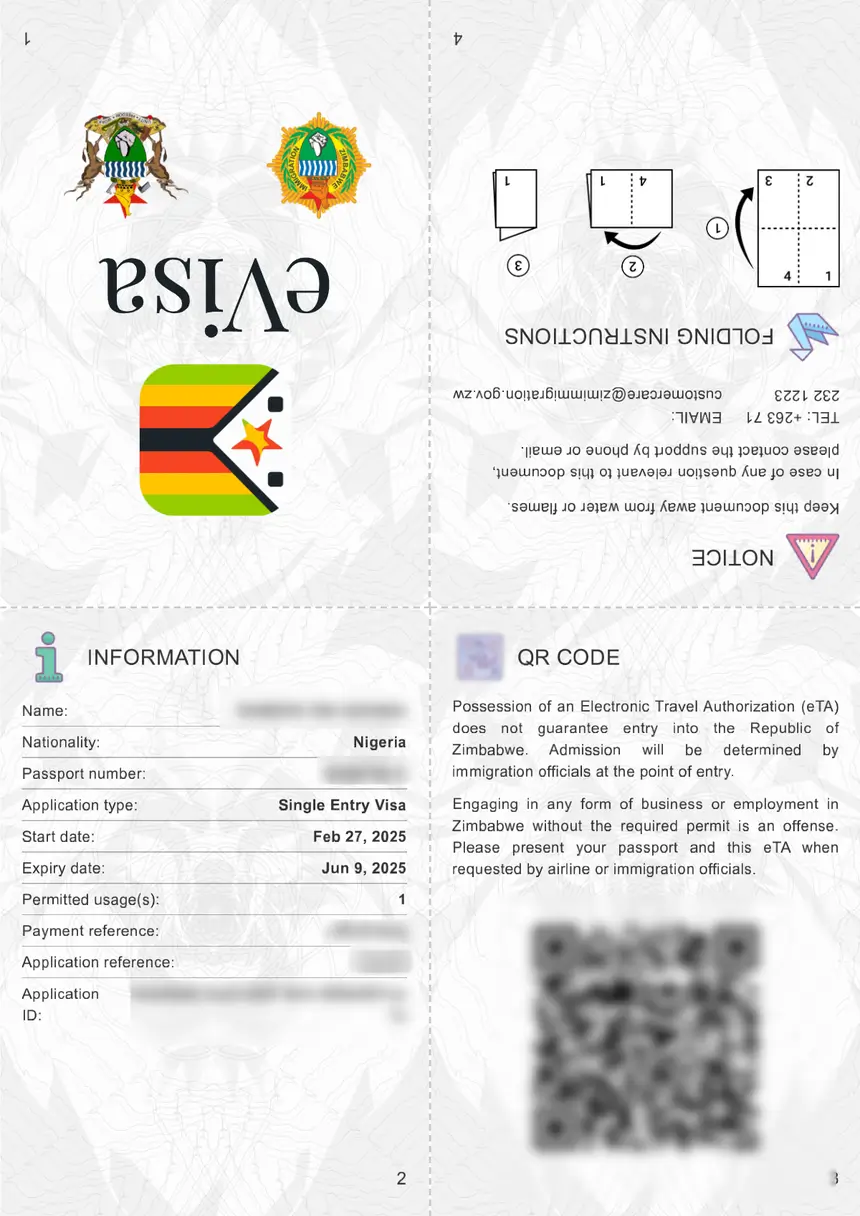
- Print or save the eVisa confirmation to present on arrival
Option 2: Visa on Arrival (Category B Countries Only)
If you are from a Category B country, you can obtain your business visa at the port of entry:
- Arrive at a Zimbabwe airport or land border
- Complete the Immigration Declaration Form (available at the counter or online in advance)
- Present your passport, business documentation, and payment
- Receive your visa stamp
Processing at the airport can take 30 minutes to over an hour depending on queues. For business travellers on tight schedules, the online application avoids this uncertainty entirely.
For a full walkthrough of the application process, see our guide on how to apply for a Zimbabwe visa.
Business Visa Processing Times
Processing times depend on how you apply and your nationality:
| Application Method | Processing Time |
|---|---|
| Online – Standard | 7-9 working days |
| Online – Rush | 5-7 working days |
| Online – Super Rush | 3-5 working days |
| Visa on Arrival | Immediate (at the port of entry) |
Category B nationals applying online typically receive approval quickly, sometimes within hours. Category C nationals should allow additional time as applications require manual review.
Business travel tip: Apply at least 2 weeks before your trip to account for any unexpected delays. If you have a conference or meeting with a fixed date, do not leave your application to the last minute.
Extending a Zimbabwe Business Visa
If your business activities require a longer stay, you can apply for a visa extension while in Zimbabwe. Here is what you need to know:
- Apply at the Zimbabwe Department of Immigration in Harare before your current visa expires
- Extensions are not guaranteed – you may need to provide a reason for your extended stay, updated proof of accommodation, and evidence of sufficient funds
- You cannot overstay your visa without facing penalties, including fines and potential bans from future entry
If you anticipate needing more than 30 days, consider applying for a multiple-entry tourist visa or discussing your situation with the Zimbabwe Embassy before travelling.
What You Can and Cannot Do on a Business Visa
A Zimbabwe business visa permits:
- Attending business meetings, conferences, and seminars
- Negotiating contracts and exploring business opportunities
- Conducting site visits and inspections
- Attending trade fairs and exhibitions
- Short-term consultancy work (where no Zimbabwe employment is involved)
A Zimbabwe business visa does not permit:
- Taking up formal employment in Zimbabwe
- Engaging in paid work for a Zimbabwe-based employer
- Volunteering or missionary work
- Studying or enrolling in educational programmes
If you intend to work in Zimbabwe, you need a temporary work permit or employment visa. For requirements, visit our Zimbabwe visa requirements page.
Ports of Entry for Business Travellers
Zimbabwe has several ports of entry convenient for business travellers:
Airports
- Robert Gabriel Mugabe International Airport (Harare) – the main international gateway and the most common arrival point for business travellers
- Joshua Mqabuko Nkomo International Airport (Bulawayo) – serves Zimbabwe’s second-largest city and industrial hub
- Victoria Falls Airport – for business events and conferences held at Victoria Falls
Land Borders
- Beitbridge (Zimbabwe-South Africa) – the busiest land border, used by many business travellers driving from South Africa
- Chirundu (Zimbabwe-Zambia) – convenient for cross-border trade
- Victoria Falls Bridge (Zimbabwe-Zambia) – popular for regional business travel
For full details on entry requirements, see our Zimbabwe eVisa requirements guide.
Frequently Asked Questions About the Zimbabwe Business Visa
Can I work in Zimbabwe on a business visa?
No. A business visa allows you to attend meetings, conferences, and explore business opportunities, but it does not permit formal employment. If you want to work in Zimbabwe, you need a temporary work permit or employment visa. See our [Zimbabwe visa requirements](/zimbabwe-evisa-requirements/) page for more information.
How much does a Zimbabwe business visa cost?
Fees depend on your nationality. For most nationalities, a single-entry business visa costs US$30 and a double entry costs US$45. UK and Irish citizens pay US$55 (single) and US$70 (double). Canadian citizens pay US$75 for single entry only. For a full fee breakdown, see our [Zimbabwe visa fee guide](/zimbabwe-evisa-fee/).
How long does it take to get a Zimbabwe business eVisa?
Standard processing takes 7-9 working days. Rush processing takes 5-7 working days, and super rush processing takes 3-5 working days. Category B nationals may receive approval faster. Category C nationals should allow additional time for manual review.
What documents do I need for a Zimbabwe business visa?
You need a valid passport (6 months validity, 2 blank pages), a passport-sized photo, a passport bio page scan, a business letter from your employer, an invitation letter from your Zimbabwe host, proof of accommodation, and a return or onward ticket. See the full document list in the requirements section above.
Can I get a Zimbabwe business visa on arrival?
Yes, if you are from a Category B country (most Western nations including the US, UK, Canada, Australia, and EU countries). However, applying online through evisa.gov.zw before you travel is recommended to avoid delays at immigration.
Can I extend my Zimbabwe business visa?
Yes. You can apply for an extension at the Zimbabwe Department of Immigration in Harare before your current visa expires. Extensions are not guaranteed and you may need to provide additional documentation.
What is the difference between a business visa and a tourist visa?
Both visas have similar fees and validity periods, but the business visa requires additional documentation including a business letter from your employer and an invitation letter from a Zimbabwe-based company. A tourist visa is for leisure travel only, while a business visa permits you to attend meetings, conferences, and conduct business activities.
Do I need a yellow fever certificate for a business trip to Zimbabwe?
Yes, if you are arriving from a country with yellow fever risk. This applies to all visa types, including business visas. Check the current list of yellow fever risk countries before travelling.
Last updated: July 2026. Visa fees and requirements are based on official Zimbabwe immigration sources. We recommend verifying current information at evisa.gov.zw before travelling.